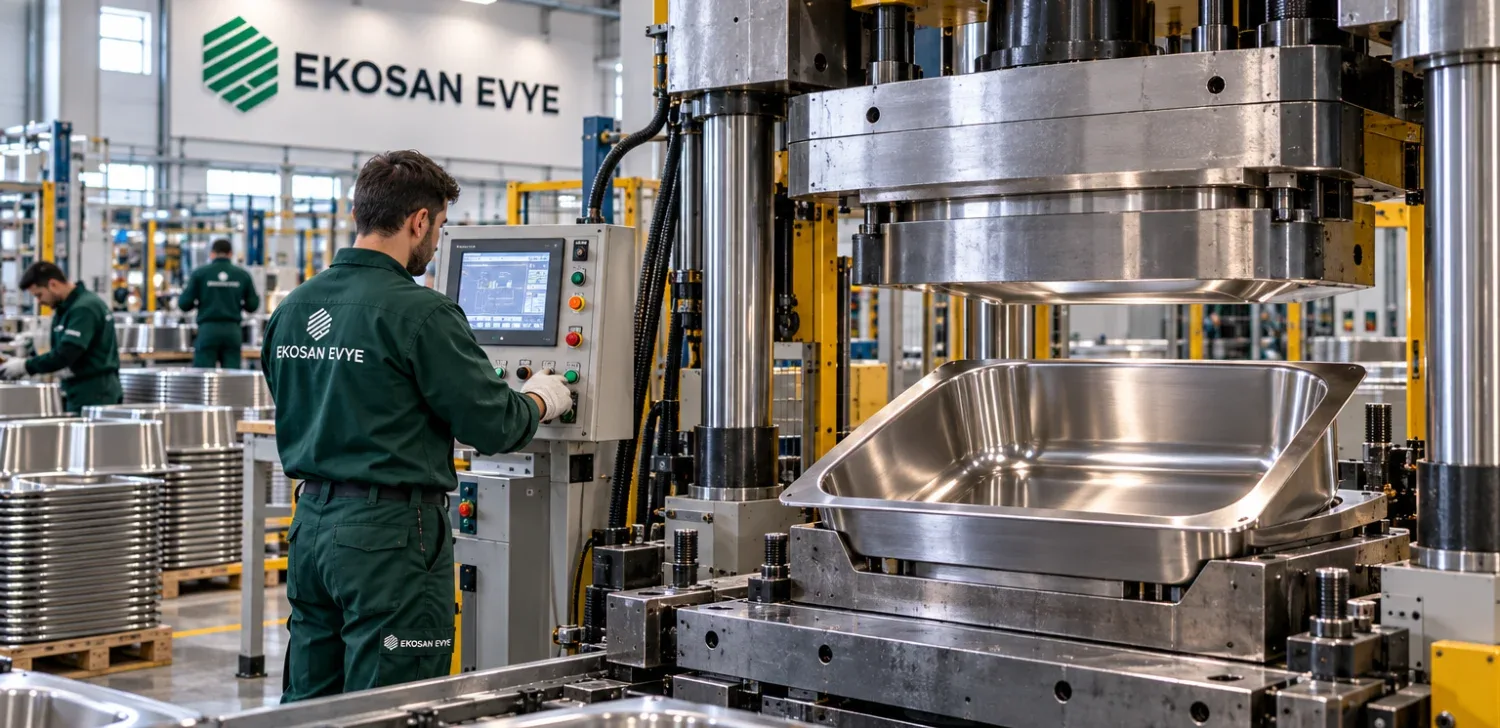
A stainless steel sink is made through a series of steps: sheet cutting, deep drawing on a hydraulic press, annealing, trimming, welding, surface finishing and quality control. In this guide, we walk you through the process step by step.
Short answer: A stainless steel sink is made by cutting stainless steel sheet supplied in coils, deep drawing it on a hydraulic press in one or two stages, annealing it where necessary, then trimming and punching holes, welding, surface finishing (satin, sandblasted or polished), quality control and packaging. A sink's bowl depth, corner radius and surface quality depend largely on the precision of the mould and the press.
At Ekosan Evye, we have been building hydraulic presses, special-purpose machinery and moulds since 1982, and manufacturing stainless steel sinks since 2002. In this article, we follow a sink step by step on its journey from a flat sheet to your kitchen.
How many stages are there in stainless steel sink production?
Although there are minor differences between manufacturers and models, the process generally consists of the following main stages:
- Raw material selection: The sink body is typically made from stainless steel sheet 0.6–1.2 mm thick. The grade (for example, 304) and the thickness directly determine the sink's strength and service life.
- Protective film and cutting: The sheet surface is covered with a protective film so that it does not get scratched in contact with the mould; the sheet is then cut to size on a guillotine shear, and its corners are chamfered to suit the shape of the sink.
- Lubrication: Drawing oil lets the sheet flow into the mould without tearing and extends the life of the mould.
- Deep drawing (hydraulic press): This is the most critical step, where the bowl takes shape. On a hydraulic press rated at hundreds of tonnes, the sheet is drawn into the mould and takes on the form of the bowl. For deep models, this is done in two stages.
- Annealing: In two-stage drawing, the part is annealed at approximately 1050–1150 °C after the first draw. This relieves the internal stresses in steel that has hardened during cold forming and reduces the risk of cracking in the second draw.
- Trimming and punching: Excess material is trimmed off, and the strainer, overflow and faucet holes are punched with a mould.
- Welding: On double bowl or combination models, the bowls are joined to the top deck by CNC-controlled welding; mounting clips and reinforcements are attached by spot welding.
- Surface finishing: The base, side walls and corners are sanded in progressive stages to produce a satin, sandblasted, mirror-polished or textured finish.
- Underside coating, cleaning and packaging: A coating can be applied to the underside of the bowl to reduce noise and prevent condensation. The product is cleaned of oil and dust, passes a final inspection and is packaged.
How do the hydraulic press and the mould affect sink quality?
During deep drawing, the sheet thins in places as it flows into the mould. Setting the press force, blank holder pressure and mould radii correctly prevents thinning, wrinkling and cracking at the corners of the bowl. That is why a manufacturer that designs its own moulds and presses can keep tighter control over both dimensional consistency and surface quality.
Ekosan Evye manufactures with its own machines and its own moulds. At the factory we established in 2015, we carry out stainless steel sink production and hydraulic press manufacturing under one roof.
What does quality control in sink production cover?
- Sheet grade and thickness measurement
- Bowl depth, dimensional and flatness checks
- Leak-tightness and visual inspection of weld seams
- Surface checks for scratches, waviness and stains
- Fit of the strainer and overflow holes
Frequently asked questions
What is deep drawing?
Deep drawing is a cold forming method in which a flat metal sheet is turned into a one-piece bowl without welding, using a hydraulic press and a mould. It allows sink bowls to be made in a single piece, without seams.
Why are sinks annealed?
Stainless steel hardens as it is formed. Annealing restores the material's ductility, so deep models can be shaped in the second draw without cracking.
How thick should the steel of a sink be?
For residential use, 0.6–1.0 mm is generally preferred, while 1.0–1.2 mm is chosen for heavy use and models with large bowls. The thicker the sheet, the better the impact resistance and sound insulation.
To explore our stainless steel sink models or request a quote for your project, visit our products page or reach us through our contact page.