For a kitchen sink, 304-grade stainless steel is usually the best choice. We explain how 304 and 201 differ in chromium, nickel and manganese content, how they compare in corrosion resistance, and what to look for when choosing.
Short answer: For a kitchen sink, the best choice is usually 304-grade stainless steel. Grade 304 contains approximately 18% chromium and 8% nickel (which is why it is also known as "18/8") and offers high corrosion resistance against moisture, food acids and detergents. Grade 201, on the other hand, is an alloy in which part of the nickel is replaced with manganese: it is more economical, but its corrosion resistance is lower.
What is the difference between 304 and 201 stainless steel?
Both belong to the austenitic stainless steel family; the difference lies in the proportions of their alloying elements:
| Property | 304 Stainless | 201 Stainless |
|---|---|---|
| Chromium (Cr) | 18–20% | 16–18% |
| Nickel (Ni) | 8–10.5% | 3.5–5.5% |
| Manganese (Mn) | 2% max. | 5.5–7.5% |
| Corrosion resistance | High; suitable for humid environments | Moderate; better suited to dry indoor spaces |
| Formability | Excellent for deep drawing | Harder and more difficult to form |
| Cost | Higher | Lower |
Chromium prevents rusting by forming a protective oxide layer on the surface of the steel, while nickel strengthens this layer and makes the material more ductile. Reducing the nickel content in 201 lowers the cost, but in environments such as the kitchen, where the surface is in constant contact with water, salt and acidic foods, it increases the risk of staining and pitting corrosion.
Why is 304 grade recommended for sinks?
- Long service life: It is more resistant to rust and staining on a sink surface that stays wet all the time.
- Hygiene: Its non-porous, easy-to-clean surface is suitable for contact with food.
- Manufacturing quality: Thanks to its ductility, deep bowls can be formed without cracking and with a uniform wall thickness.
- Appearance: Satin and polished finishes keep their look better over the years.
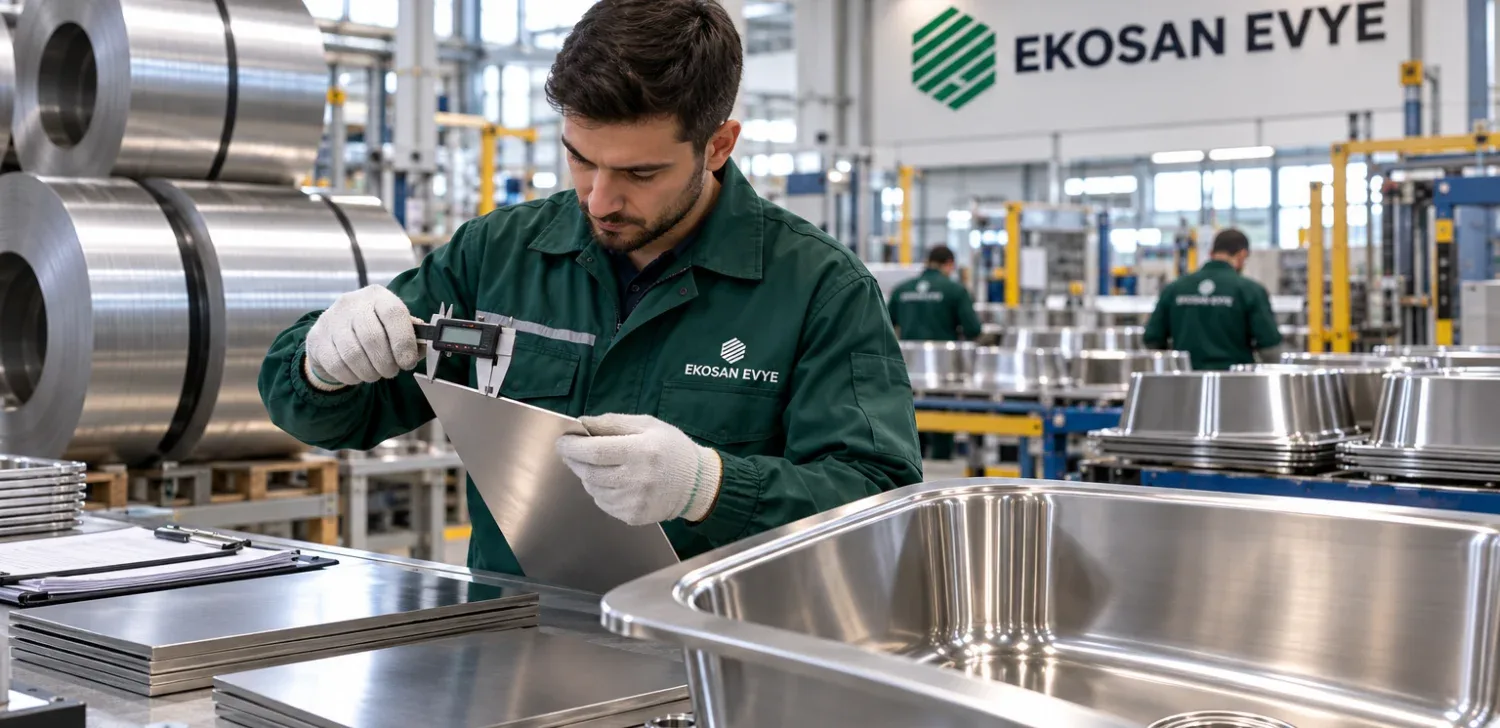
Ekosan Evye manufactures 304-grade stainless steel sinks in its Inset, Lay-on and Undermount series.
How can I tell which grade my sink is made of?
The most reliable way is to ask the manufacturer for a material certificate or the product's technical data sheet. A magnet test is not conclusive: 304 is normally non-magnetic, but it can become slightly magnetic after cold forming. In professional inspections, the alloy composition is measured with XRF analysers.
Does sheet thickness matter too?
Yes. Sheet thickness matters just as much as the material grade. The common range for residential sinks is 0.6–1.2 mm. Thicker sheet is more resistant to impact, denting and vibration, and it dampens the sound of running water better.
Frequently asked questions
Does a 304 stainless steel sink rust?
Not under normal use. However, iron particles left on it for a long time (steel wool, a rusty pan) can leave rust stains on the surface; such a stain is rust from the iron that was in contact with the sink, not from the sink material itself, and it can be removed with a suitable cleaner.
Is a 201-grade sink a bad choice?
No, but it should be chosen according to where it will be used. It can be used in dry, well-ventilated areas; for kitchen sinks that are constantly wet, 304 lasts longer.
Do I need a 316-grade sink?
316 is a molybdenum-bearing grade with higher resistance to chlorides. It may be preferred in special environments such as seaside locations and industrial kitchens; for standard residential kitchens, 304 is sufficient.
You can explore our 304-grade stainless steel sink models on our products page.