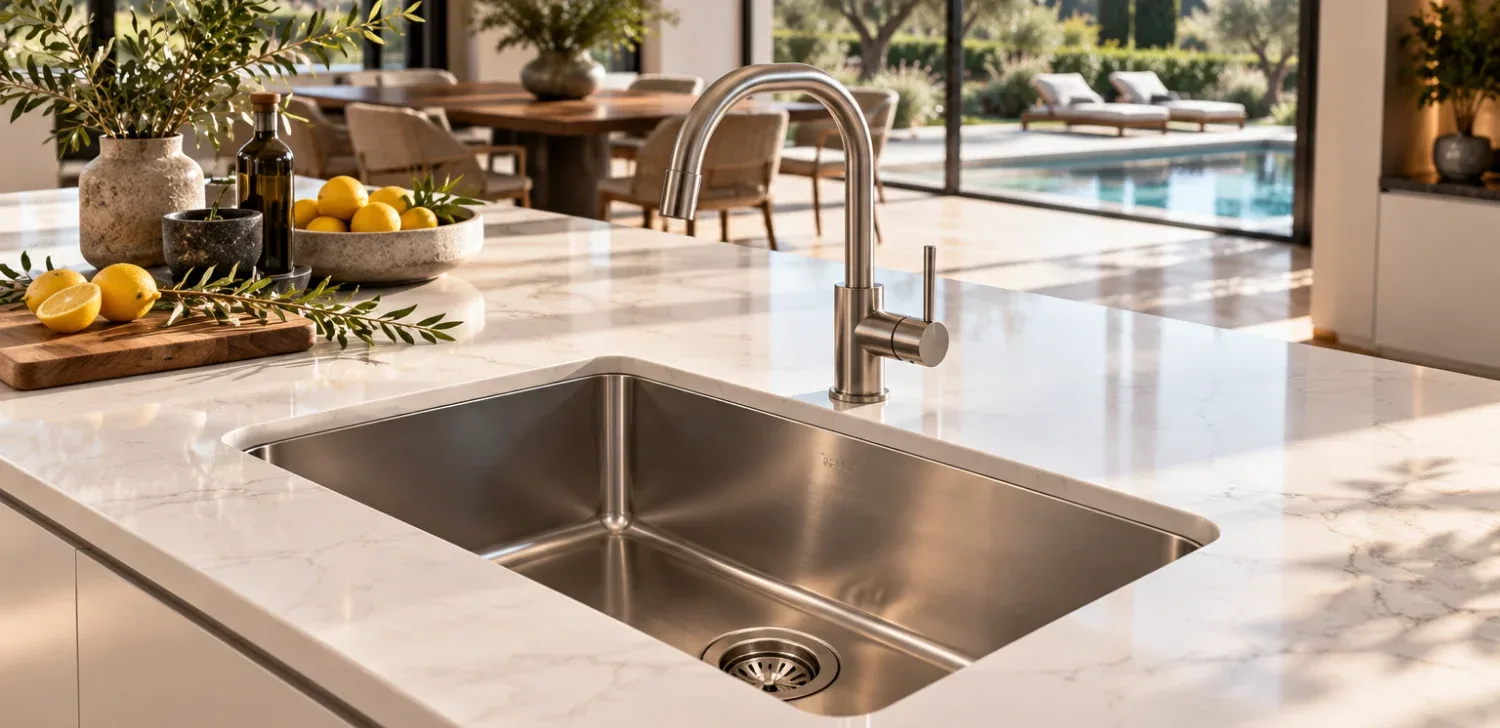
Depending on how they are fitted to the countertop, sinks fall into three types: inset (drop-in), lay-on (sit-on) and undermount. We explain how they differ, what their advantages are and which type suits which countertop.
Short answer: Depending on how they are fitted to the countertop, sinks fall into three main types. An inset (drop-in) sink sits in a cut-out in the countertop, with its rim resting on the countertop surface. A lay-on (sit-on) sink rests directly on the base cabinet and takes the place of the countertop. An undermount sink is mounted beneath the countertop; its rim is hidden, and the countertop surface flows seamlessly down into the bowl.
What is an inset (drop-in) sink?
The inset sink is the most common mounting type. A cut-out matching the sink's dimensions is made in the countertop, the sink is lowered into it, and its rim flange rests on the countertop and is secured with clips. It is compatible with almost any countertop material, including laminate, wood, quartz and granite.
- Advantages: Easy installation, a wide choice of models, extra work space with drainboard models, and easy replacement later on.
- Points to watch: A sealing gasket or silicone must always be applied where the rim meets the countertop to keep water out.
What is a lay-on (sit-on) sink?
A lay-on sink does not fit into a countertop cut-out; instead, it sits on top of a standard-size base cabinet. The sink's top deck takes the place of that section of the countertop. It is typically chosen for budget projects, mass housing and kitchens that need a quick installation.
- Advantages: No countertop cut-out is needed, and installation is quick and economical.
- Points to watch: The sink dimensions must exactly match the base cabinet dimensions (for example, 80, 100 or 120 cm modules).
What is an undermount sink?
An undermount sink is attached to the underside of the countertop with special fixings and adhesive. The cut edge of the countertop slopes down towards the bowl, so water and crumbs on the countertop can be swept straight into the sink.
- Advantages: A minimal, modern look, no dirt build-up around the rim, and easy cleaning.
- Points to watch: It requires a water-resistant countertop whose cut edge can be finished, such as granite, quartz or compact laminate; installation calls for professional workmanship.
How do the mounting types compare?
| Inset | Lay-on | Undermount | |
|---|---|---|---|
| Countertop cut-out | Required | Not required | Required (with edge finishing) |
| Suitable countertops | Almost all | Replaces the countertop | Granite, quartz, compact laminate |
| Appearance | Classic | Practical | Minimal, modern |
| Cleaning | Easy | Easy | Easiest |
| Installation | Easy | Easiest | Professional |
Which mounting type is used for a granite sink?
Composite granite sinks are most often installed as inset (drop-in, on top of the countertop) sinks; some models are also suitable for undermount installation or for flush mounting, level with the countertop. When choosing a model, always follow the manufacturer's installation instructions.
Frequently asked questions
Which sink mounting type is the most durable?
Durability depends less on the mounting type than on the sink's material, sheet thickness and the quality of the installation. A properly sealed inset sink and a properly installed undermount sink will both give many years of trouble-free use.
Can an undermount sink be fitted to a laminate countertop?
This is not recommended for standard laminate countertops, because the cut edge is left unprotected against water. For these countertops, an inset sink is the safer choice.
How do I choose the right sink size?
Consider the base cabinet width, the countertop depth and your usage habits together. As a rule, the sink should be a few centimetres narrower than the base cabinet.
You can compare Ekosan Evye's Inset, Lay-on, Undermount and granite series on our products page.